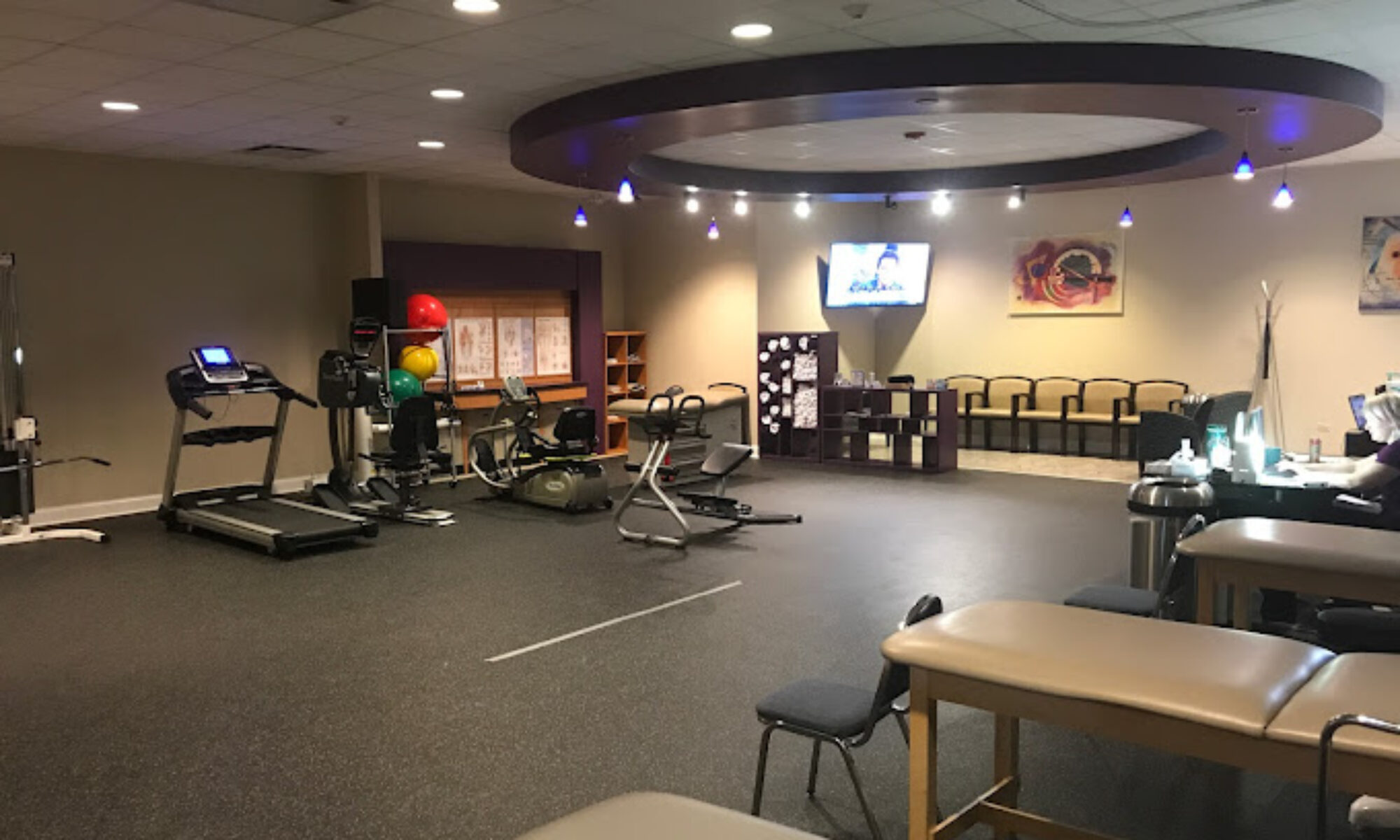

Physical therapy services are integral to patients struggling with chronic diseases, serious injuries, or post-surgery care. One facility that is known for offering cutting-edge physical therapy treatments and rehabilitation programs is UT Health East Texas Rehabilitation Center.
This facility aims to help patients regain their mobility and function optimally through an array of acute care services. The 49-bed facility comprises of a team that utilizes advanced therapy techniques and hospitalization services for optimal recovery.
The center offers both inpatient and outpatient rehabilitation services. The inpatient program offers trauma care, diagnostic and laboratory services, hemodialysis services, limb loss rehabilitation, and wound care services. A large team of specialists from different fields like occupational therapy, pastrol care, physical therapy, and psychology is available to assist patients on their recovery journey.
For patients who have suffered a stroke, a specialized stroke rehabilitation program is available to help them recover their motor skills, speech, and cognitive functions. Additionally, their transitional living apartments bridge the gap between hospital care and independent living, providing a supportive environment for recovery.
The center also offers a variety of outpatient rehabilitative care options. These include aquatic therapy, balance and vestibular programs, lymphedema management, cardiopulmonary rehabilitation, and dry needling. Specialized therapy plans are available for patients with Parkinson’s disease, including a community wellness program tailored to their needs.
Patients with orthopedic disabilities, hand injuries, occupational injuries, neurological dysfunction, and arthritic conditions are offered orthotic therapy. Moreover, programs exist with the aim of helping patients regain function, mobility, and independence after limb loss, including personalized therapy plans, prosthetic training, pain management, and emotional support services.
The Physical Therapy wing of UT Health East Texas Rehabilitation Center utilizes durable medical equipment, home evaluations, and post-discharge support in their customized therapy plans. Their professional speech therapists also work with patients overcoming difficulties with communication, organization of thought, and swallowing issues.
The center is constantly upgrading its facilities for the convenience and comfort of its patients. Recently, there was a driveway repaving exercise that temporarily changed vehicular and pedestrian access. However, patients and visitors are well-informed and guided about the changes.
UT Health East Texas Rehabilitation Center’s constant push for improvements and advancements in their physical therapy services and treatments reflects their core mission to provide excellent medical care to their patients. Their carefully designed programs and treatments are designed to ensure that every patient receives personalized, effective, and quality healthcare services.
Physical therapy can make a significant difference in a patient’s life, improving their quality of life, independence, and overall health. Rehabilitation centers like UT Health East Texas are key in providing these services, and their vast range of therapies and treatments ensure that patients get the specialized care they need to recover and regain their independence. This holistic approach to patient care is crucial in ensuring an effective recovery process for each patient.
Their efforts not only aid in the physical recovery of patients but also in building emotional resilience to cope with the impacts of severe illnesses, injuries, or post-surgery conditions.
In conclusion, UT Health East Texas Rehabilitation Center demonstrates a deep commitment to helping their patients recover wholesomely through their extensive range of physical therapy services and treatments.
Whether a patient is in need of inpatient or outpatient services, this center has a robust system that can cater to their unique needs. By integrating modern rehabilitation techniques with compassionate care, they are truly spearheading advancements in physical therapy treatments.
Physical therapy services and treatments are rapidly evolving with advancements in technology and research, bringing forth innovative approaches to restoring function and enhancing mobility after injuries and illnesses. Today, these services are not only limited to adults but also extend to pediatrics, providing targeted and personalized care to young patients. Two prominent institutions leading the charge in this sphere are Mayo Clinic and the Hospital for Special Surgery (HSS), both offering a broad spectrum of therapeutic interventions and advanced rehabilitation programs.
At Mayo Clinic, the Physical Medicine and Rehabilitation (PM&R) program focuses on restoring function to individuals hampered by various medical conditions impacting the brain, spinal cord, nerves, and musculoskeletal system. The overall aim is to maximize the potential of each patient, allowing them to regain optimal functionality and quality of life in accordance with their specific needs.
In this vein, Mayo Clinic’s PM&R delivers a multidisciplinary approach to rehabilitation, bridging expertise across various specialties. Teams comprising physicians, therapists, and advanced care providers coordinate efforts to offer integrated solutions, whether in a hospital or clinical setting. Their services are encompassing, addressing all forms of traumatic or nontraumatic injuries and leveraging extensive experience in interpreting medical images and carrying out physical examinations of bones, joints, and muscles.
A strong point in Mayo Clinic’s PM&R program is the focus on advanced therapeutic expertise demonstrated in their comprehensive treatment options. These range from utilizing physical modalities such as custom orthotics and ultrasound to offering therapeutic exercise and manual therapy engineered to improve movement and expedite healing. This, complemented by patient education initiatives, ensures a holistic approach.
Another noteworthy area of expertise that the Mayo Clinic offers is Assistive and Restorative Technology services. They use state-of-the-art technology through their Assistive and Restorative Technology Laboratory (ART Lab) that offers advanced prosthetic options, functional electrical stimulation, and 3D computer technology and printing for braces. This lab is spearheading clinical research to continuously improve patient care, showcasing the crucial role of technology in physical rehabilitation.
Meanwhile, the HSS Pediatric Rehabilitation & Young Athlete Center is earning recognition as a leading pediatric outpatient rehabilitation resource in New York City. Offering specialized programs to address rehabilitation needs, enhance sports performance, and minimize injury risk in young patients, this center underlines the crucial role of tailored therapy interventions for children and adolescents.
The multidisciplinary team at HSS includes physical, occupational, and speech therapists who provide advanced training in neurodevelopmental, orthopedic and sports rehabilitation. The center is comprehensively equipped with two physical therapy gyms, an occupational therapy gym with a climbing wall and specific sensory equipment, and private speech therapy rooms.
Notably, HSS takes a kid-centric approach, crafting personalized, holistic, and engaging programs. Therapy services can be accessed through referrals from doctors, physician’s assistants, or nurse practitioners, ensuring all-inclusive care. They even boast a dedicated Equipment and Assistive Technology Clinic to support children requiring mobility equipment and augmentative communication tools.
In summary, Mayo Clinic and HSS offer inspiring models of contemporary physical therapy services and treatments. Their comprehensive, patient-centered, and multidisciplinary approach, coupled with the incorporation of cutting-edge technology, showcases the promising trajectory of physical rehabilitation. These institutions reassure patients of all ages that overcoming physical limitations and regaining functionality can be achieved through advanced therapy and unwavering dedication to patient care. Their model of care delivery sets a high standard for other institutions aspiring to provide exceptional physical therapy services. In this view, the future of physical rehabilitation is indeed bright, innovative, and enriched by technology.
North America
Europe
Asia-Pacific
Latin America
Middle East & Africa
Forecast Period 2025 to 2034
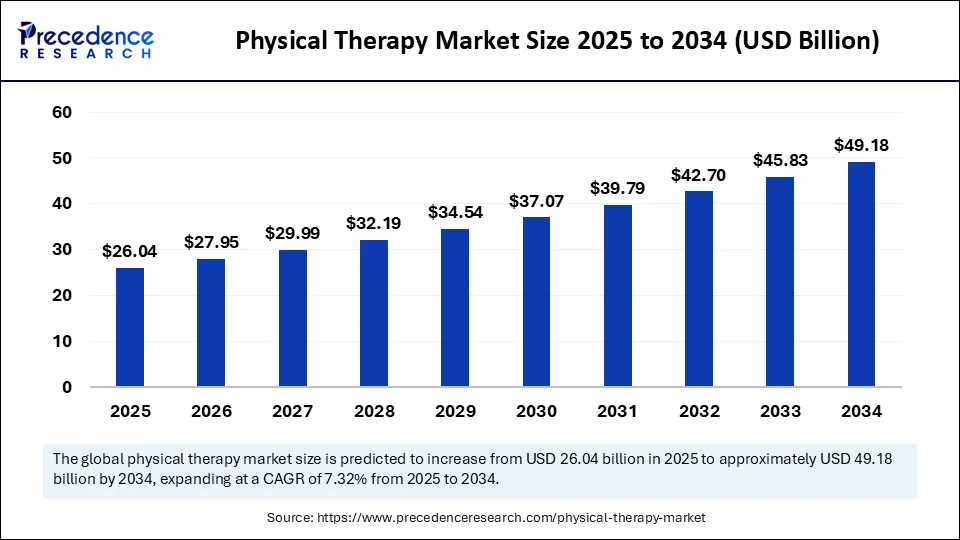
By market size and estimated growth, the global physical therapy market is set to experience significant growth. The current fascinating times offer excellent opportunities for the physical therapy markets to reach USD 49.18 billion by 2034, expanding at a 7.32% Compound Annual Growth Rate (CAGR) between 2025 and 2034, from an estimated USD 26.04 billion in 2025.
The market is currently propelled by various factors, such as an increasing aging population which ultimately leads to increased prevalence of chronic conditions like arthritis and stroke requiring physical therapy. In conjunction, an observable increase in health consciousness following Covid-19 has pushed individuals to seek preventive and therapeutic care.
Technological advances in the field of physical therapy such as the integration of artificial intelligence, virtual reality, and robotic systems have played a major role in growing the market size, by making treatment more dynamic, productive and engaging for patients. Additionally, there has been an increase in insurance coverage for physical therapy which has solidified the therapy’s position as an integral part of modern wellness strategies.
Looking at specific geographies, North America currently holds the dominant position in physical therapy market share with 40% in 2024. This attribute is due to establishments of healthcare infrastructure, heightened awareness regarding physical rehabilitation, and a high prevalence of chronic and lifestyle-related disorders. Asia-Pacific, however, is anticipated to expand at the highest CAGR in the coming years due to a surge in modern healthcare, increased disposable incomes, and growing awareness of rehabilitative care.
AI has successfully reshaping the landscape of physical therapy market by providing smarter, personalized rehabilitation strategies. With the help of AI-powered platforms, therapists can track patient progress in real-time, forecast recovery timelines and adjust therapy plans accurately. AI support an analytical approach by identifying trends, detect unusual early symptoms and enhance diagnostic accuracy.
On the segmental front, orthopedic physical therapy held the largest share in the market in 2024. This was due to high prevalence of musculoskeletal disorders, sports injuries and post-surgical rehabilitation needs. Neurological physical therapy segment, on the other hand, is expected to grow at the highest CAGR between 2025 and 2034. This could be attributed to a growing number of patients with stroke, Parkinson’s disease, spinal cord injuries, multiple sclerosis and traumatic brain injuries; these conditions require long-term continuous rehabilitation, making neurological physiotherapy increasingly important.
In the age group sector, adults held the leading position in the largest market share in 2024 due to increased prevalence of lifestyle-related musculoskeletal issues and increased participation in fitness and sports whereas, elderly segment is expected to grow at a fast pace in the coming years due to rising life expectancy and an increase in age-related conditions such as osteoporosis, arthritis, and neurodegenerative disorders.
Lastly, hospital segment dominated the market with the highest share in 2024 due to their comprehensive rehab infrastructure, skilled professionals, and access to multi-disciplinary care. However, outpatient clinics segment is expected to see a substantial rise due to cost-effective, flexible and accessible services for patients who prefer home-based or part-time care.
Leading companies in the market include AmeriCare Physical Therapy, Rehab Alternatives PLLC, PIVOT Physical Therapy, ProHealth Limited, BTL, DJO LLC, Performance Health, Athletico Physical Therapy, Geisinger Health, Select Medical Corporation, Knight Health Holdings, Concentra, Inc., EMS Physio Ltd., with U.S. Physical Therapy, Inc. and Isokinetics leading the US market.
In conclusion, with an increasing demand for rehabilitative services and rising integration of technologically advanced tools, the physical therapy market has a promising foreseeable future. However, despite these advances, there still exists barriers to affordable and accessible therapy in rural and low-income regions which will need to be addressed.
Physical Therapy’s response to the COVID-19 pandemic has revived discussions around the integration of physiotherapy services into national and subnational health emergency preparedness planning. According to a recent global survey conducted by World Physiotherapy in cooperation with the World Health Organization (WHO), rehabilitation services are often acknowledged as integral parts of robust health systems during emergencies, yet they frequently get disrupted and overlooked at such times.
Survey Results & Discussion
The World Physiotherapy annual membership census was taken by 116 out of 125 member organisations. The report revealed that 24% of the surveyed organisations did not adopt any of the listed mitigation strategies during the pandemic. Additionally, it surfaced that 64% of the member organisations reported a lack of inclusion of physiotherapy services in health emergency preparedness planning in their respective countries/territories.
The COVID-19 pandemic served as a global reminder of the significant role rehabilitative services can play in acute clinical care, post-acute follow up, and long-term rehabilitation for conditions such as Long COVID. The pandemic, however, led to severe disruptions to rehabilitation services, necessitating a greater focus on integrating rehabilitation into health emergency preparedness.
Methodology
The questions for the survey were developed in line with WHO recommendations and classified based on World Physiotherapy regions and country/territory income level classifications. The AMC questions were written in English and translated into French and Spanish, and responses were collected from different MOs across regions.
Results showed that measures for emergency preparedness varied among different regions and income levels. For instance, telerehabilitation was the most frequently reported mitigation strategy in high-income regions, while in Africa, home-based care was the primary mitigation strategy due to the region’s high percentage of low-income countries.
Further Advocacy and Recommendations
The study suggests an urgent need for escalated advocacy and awareness efforts on integrating rehabilitation services into national and subnational planning. The WHO initiated policy brief on Strengthening Rehabilitation in Health Emergency Preparedness, Readiness, Response and Resilience can serve as a robust advocacy tool for the same.
In addition, future annual membership censuses (AMC) should continue to include questions on mitigation strategies and preparedness measures for a more in-depth understanding of global physiotherapy practices.
Veterans transport service, such as the DAV vans in coordination with Disabled American Veterans and county Veterans Affairs directors, is a unique service aimed at providing transportation to veterans and authorized caregivers for their medical appointments.
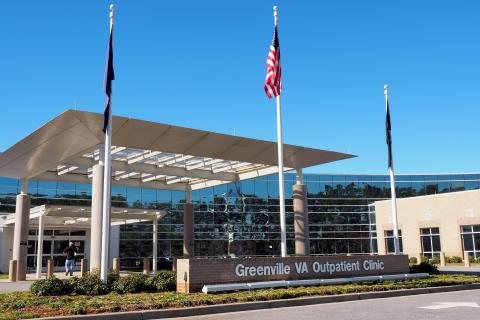
Clinics like the Lance Corporal Dana Cornell Darnell VA Clinic in Columbia, South Carolina, also offer beneficiary travel benefits which include round-trip transportation from home to the medical center, and mileage reimbursement.
Conclusion
Physical therapy services have shown their crucial role in warding off the impacts of global health crises like the COVID-19 pandemic. While the global response to physiotherapy disruptions has highlighted innovative mitigation strategies, a significant gap remains in integrating these services into health emergency preparedness planning. International organizations, national governments, and relevant stakeholders need to amplify their support to address this gap effectively.
Sources:
 Physical Therapy and Rehabilitation
 Physical Medicine and Rehabilitation – Overview
 HSS Pediatric Rehabilitation and Young Athlete Center
 Physical Therapy Services Now Available at Sanford West Fargo
 Physical Therapy Market Size to Hit USD 49.18 Billion by 2034
 Lance Corporal Dana Cornell Darnell VA Clinic | VA Columbia South Carolina health care | Veterans Affairs
 Global response to physiotherapy services disruptions during the COVID-19 pandemic and the level of preparedness for the next health emergency

