
Article:
Physical therapy is an essential aspect of healthcare, aiding patients in their journey of recovery and regaining functionality after various health issues. New advancements and strategies in physical therapy are continuously evolving, increasing the effectiveness of the treatments and resulting in improved patient care. This article delves into recent trends in the field of physical therapy, bringing attention to changes in both outpatient and in-home rehabilitation services and innovative programs.
At UT Health Pittsburg, renowned for its exceptional rehabilitative care, the team is committed to providing exhaustive rehabilitation services for various medical conditions, including cardiopulmonary problems, joint pain, balance disorders, and neurological disorders like stroke. Using the latest techniques in physical therapy, they employ a patient-centric approach to stimulate cognitive function, improve posture, balance, pain management, and increase strength and endurance.
Transitioning to a new era of healthcare, UT Health Pittsburg, in collaboration with Choice Health At Home, now provides at-home rehabilitation services. The intent is to deliver quality healthcare right at the patient’s doorsteps, ensuring they receive the best possible care in a familiar, comfortable environment. The services provided by Choice At Home range from physical therapy to specialized rehabilitation and hospice care.
Another remarkable initiative by UT Health East Texas is their Olympic Fitness Centers. The center focuses on promoting fitness and overall well-being by offering a wide range of fitness classes, personalized training, and custom fitness programs. The fitness centres, linked to the region’s premier healthcare network, are staffed by experts trained to integrate a medical approach with fitness management. The initiative caters not just to patients but is open to the wider public as well.
A standout program that warrants special mention is the “Swing Bed” program by UT Health Pittsburg. This program is envisioned to facilitate patients to transition from hospitalization back into the community at their previous level of independence. They stay in the same hospital room with a familiar medical team while they continue to heal. The Swing Bed program is intended for short-term rehabilitative services and focuses on delivering supreme quality inpatient and outpatient care.
The criteria to qualify for the Swing Bed program include a minimum three-day stay as an acute care patient, requiring ongoing monitoring and rehabilitative care, having Medicare as primary insurance, and doctor referral. The average length of stay is usually between one and two weeks, seldom exceeding three weeks. Once patients are ready to depart the program, a case manager ensures a smooth transition, connecting them with home healthcare and outpatient therapy options.
UT Health Pittsburg and UT Health East Texas are examples of institutions that strive to revolutionize physical therapy services, making the process more efficient, conducive, and less stressful for patients. From comprehensive in-center therapy to in-home care and fitness initiatives, these institutions seem to have a grasp on the changing dynamics of physical health and rehabilitation services. They are moving steadily towards a future that promises improved health and better quality of life for patients, highlighting the potential of contemporary physical therapy services in modern healthcare.
In summary, the landscape of physical therapy is continually expanding. The integration of home-based healthcare services, personalized fitness programs, and innovative solutions like the Swing Bed program are game-changing trends that may alter the future of physical therapy, casting a hopeful light on the future of patient care.
Physical therapy services and rehabilitation treatments continue to improve and advance, offering a wide range of options for patients affected by a variety of medical conditions. Organizations such as Mayo Clinic and the Hospital for Special Surgery (HSS) are leading the way in comprehensive and personalized treatments, using advanced technology, multidisciplinary teams, and customizable care plans.
Mayo Clinic’s Physical Medicine and Rehabilitation (PM&R) department is renowned for its unique approach to restoring function in patients suffering from diseases or injuries that limit their mobility or physical functionality. Integrating various specialties, PM&R professionals focus on devising individualized care plans catered towards the unique needs, abilities, and goals of each patient.
Specialists in PM&R tackle a broad array of medical conditions affecting the brain, spinal cord, nerves and the musculoskeletal system. Treatment options can range from physical modalities such as custom orthotics and ultrasound, to therapeutic exercise and manual therapy. Educating patients about their conditions and rehabilitative care forms an important part of the treatment process.
The Mayo Clinic boasts several key areas of expertise; from bone, muscle and soft tissue therapies, gaming and eSports medicine, to Adaptive Athlete medicine and pediatric rehabilitation. An emphasis is also placed on advancements in assistive and restorative technology. The Assistive and Restorative Technology Laboratory (ART Lab) utilizes cutting-edge technology in therapy and testing procedures. Innovations include 3D computer technology and printing for hand/wrist braces, assistive technology for spinal cord injury, functional electrical stimulation, and advanced prosthetic options for patients with amputations.
HSS’s Pediatric Rehabilitation and Young Athlete Center in New York City is another leading figure in pediatric rehabilitation and outpatient services. The facility houses physical, occupational, and speech therapists who are specifically trained in neurodevelopmental, orthopedic and sports rehabilitation.
For young athletes, tailored programs are designed integrating clinical expertise, state-of-the-art technology, and equipment. This is aimed at addressing rehabilitation needs, enhancing sports performance while minimizing injury risk. Infants and toddlers can access dedicated spaces to improve motor skills, functional abilities, balance, and coordination.
The facility includes two physical therapy gyms designed for specialized and individual care. Other features include an occupational therapy gym with a climbing wall, age-specific sensory equipment, a fine motor hand therapy space, and private speech therapy rooms with SMART Board™ access for patients with language and communication therapy needs. A dedicated Equipment and Assistive Technology Clinic provides support for kids in need of mobility equipment, assistive devices, or augmentative communication tools.
HSS’s Pediatric Rehabilitation offers care that is consultative, personalized, holistic, and fun. Their services range from consultations to intensive programs based on therapist examination and plan of care. Above all, collaboration between healthcare professionals is fundamental to the delivery of effective care. Communication between pediatricians, physiatrists, orthopedic surgeons, and neurologists is essential to achieve the best treatment outcomes for patients.
In a nutshell, both Mayo Clinic and HSS are excelling in their provision of physical therapy services and rehabilitation treatments. Grounded in exceptional expertise, advanced technology, and evidence-based care, both institutions are making impressive strides in restoring function, aiding recovery, and enhancing the quality of life for patients with debilitating illnesses or injuries.
Title: Elevating Healthcare Access: Physical Therapy Services Now At Sanford West Fargo and Lance Corporal Dana Cornell Darnell VA Clinic
In the swiftly evolving landscape of healthcare, physical therapy is being recognized as a crucial service. Not only does it assist in the rehabilitation progress, it helps patients resume their normal life while preventing future injuries. Recently, two healthcare facilities have announced expansions in their physical therapy offerings that cater to veterans and the general public.
At Sanford Health West Fargo, North Dakota, efforts have been made to increase the availability of physical therapy services. Sanford believes that every patient’s recovery journey is crucial to their goal of returning to normal life, and to this end, they have expanded their services to a new location.
Each patient gets to work individually with an experienced physical therapist who helps their body naturally heal itself. The physical therapists at Sanford are trained to evaluate, treat, and prevent mobility disorders, thus assisting their patients to recover safely and regain mobility.
In a statement released recently, David Tompkins, Sanford Health lead physical therapist said, “We are thrilled to provide our community with an additional venue for physical therapy services.” Their commitment towards the well-being of the community is fortified by this expansion which brings care closer to the patients’ homes.
Sanford’s physical therapy spectrum includes a variety of services and therapies ranging from managing dizziness and imbalance, dry needling, LSVT BIG treatment for Parkinson’s, lymphedema therapy, orthopedic care, pain management, postoperative services, stroke rehabilitation, to women’s health care.
With a flexible schedule from Monday to Friday, 7 a.m. to 5 p.m., patients can reach out to Sanford West Fargo to book their appointment for physical therapy sessions.
Meanwhile, in South Carolina, the Lance Corporal Dana Cornell Darnell VA Clinic is offering van services for veterans. These services are provided in conjunction with Disabled American Veterans (DAV) and county Veterans Affairs directors. Their shared goal is to aid veterans and authorized caregivers logistics to access medical appointments and other healthcare services.
While individual van schedules may vary depending on the locality, veterans have assistance from various services including DAV and non-DAV van services, with more information on offer about these services within their respective counties.
Looking to the future, the VA Clinic aims to enhance physical healthcare access by considering implementing a shuttle service and local transportation services. These offerings are in line with their existing beneficiary travel benefits, which encompass round-trip transportation from home to medical center, mileage reimbursement, and special mode transport for eligible veterans.
These new offerings from both Sanford Health West Fargo and Lance Corporal Dana Cornell Darnell VA Clinic exemplify the efforts being made across the healthcare industry to prioritize patient recovery and wellbeing. Whether it’s additional locations to provide care closer to home or transportation services to ensure veterans can access their medical appointments, these steps are moving healthcare in the right direction – towards greater accessibility and patient-centered care.
North America
Europe
Asia-Pacific
Latin America
Middle East & Africa
Physical and Occupational Therapy News
Access changes to Yawkey, Menino, and Moakley buildings due to re-paving of the main driveway have been scheduled for October 17-19 and October 24-26. During this period, patients and visitors are asked to use the entrance on East Concord Street. Vehicular traffic should use the designated drop-off and pick-up zone on East Concord Street or the 710 Albany Street Garage. The construction-tolerant redesign of the campus can be further explored online.
Physical Therapy Market Growth
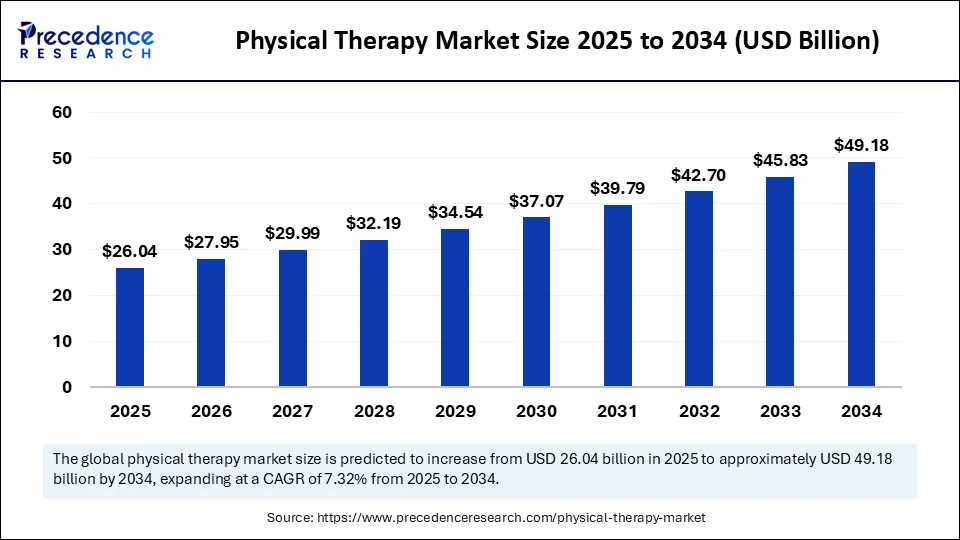
According to recent forecasts, the physical therapy market size is predicted to rise steeply from USD $24.27 billion in 2024 to approximately USD 49.18 billion by 2034, marking an expansion at a CAGR of 7.32% from 2025 to 2034. This growth is driven by increasing awareness of musculoskeletal health, a growing geriatric population, and rising demand for post-operative rehabilitation services. The integration of Artificial Intelligence (AI) technologies is revolutionizing physical therapy by introducing smart, data-driven, personalized therapeutic strategies.
In 2024, North America accounted for 40% of the market share. The region’s well-established healthcare infrastructure, high prevalence of chronic conditions, and comprehensive insurance coverage for physiotherapy services led to this dominance in the physical therapy market.
However, Asia-Pacific is expected to expand at the highest CAGR in the coming years due to modernizing healthcare infrastructure, growing disposable income, and greater awareness about rehabilitative care.
AI and Physical Therapy
AI is ushering in a new era in the physical therapy industry, making traditional rehabilitation practices more effective. AI-powered platforms can track patient progress in real-time, predict recovery timelines, and adjust therapy plans accurately. The use of motion sensors, computer vision, and machine learning algorithms in monitoring patient movements and providing instant feedback reduces the need for consistent patient supervision.
AI also aids practitioners by analyzing vast datasets, spotting early trends, detecting anomalies, and improving diagnostic accuracy, thus increasing the efficacy of the treatment. AI-driven technological advances such as robotic-assisted therapy and intelligent wearables that assess muscle activity are helping the physical therapy industry scale up while maintaining a customized approach.
Physical Therapy Market in Various Regions
In 2024, the U.S. physical therapy market size was valued at USD $7.38 billion and is projected to reach USD $15.24 billion by 2034, marking a CAGR of 7.52% from 2025 to 2034.
The Asia Pacific physical therapy market is set to grow at the fastest CAGR during the forecast period, driven by the modernization of healthcare infrastructure, rising disposable incomes, and increasing awareness about the benefits of rehabilitative care. Government health initiatives in countries like India and China are further supporting the growth.
The physical therapy market in Europe is significantly expanding, driven by an aging population and increasing focus on non-pharmacological approaches to pain and mobility management. Support from government bodies towards universal healthcare and physical therapy reimbursements under national health schemes is further driving market growth.
Conclusion
The global physical therapy market is witnessing significant growth due to several factors such as the aging population, rise in health consciousness following the pandemic, increased prevalence of sedentary habits and poor posture, and increasing need for post-operative rehabilitative measures. Technological advances such as AI integration, virtual reality, and other digital health strategies are making the services of physical therapists more accessible, effective, and patient-centric. The increased insurance coverage for physiotherapy services is solidifying its role in modern wellness strategies. Affordable AI tools, mobile rehab apps, wearable technologies, telerehabilitation, and home-based care are some of the innovations that physiotherapists, sports clinics, orthopedic centers, and tech innovators use to deliver personalized therapy experiences to patients in their own homes.
Sources:
 Physical Therapy and Rehabilitation
 Physical Medicine and Rehabilitation – Overview
 HSS Pediatric Rehabilitation and Young Athlete Center
 Physical Therapy Services Now Available at Sanford West Fargo
 Lance Corporal Dana Cornell Darnell VA Clinic | VA Columbia South Carolina health care | Veterans Affairs
 Physical Therapy Market Size to Hit USD 49.18 Billion by 2034